Tag Archives: Security

Chromebleed Notifies You if a Visited Site was Hit by Heartbleed Bug

The Heartbleed bug is among the major security vulnerabilities we have seen in recent times. It’s one of those cases where precaution is the order of the day. You could manually check sites or use Chromebleed, an extension that tells you if the site you’re on was affected by the bug.

Chromebleed uses Filippo Valsorda’s little tool to test if the page was hit by Heartbleed and hasn’t issued a patch yet. You’re going to be safe on the bigger websites like Yahoo, but there’s a chance that some of the smaller sites haven’t yet patched their servers, so this little protection will help. If you do visit some such site, Chromebleed will throw a notification warning you, in which case it’s best to exit and notify the site’s developers to fix their issue.

Chromebleed Notifies You if a Visited Site was Hit by Heartbleed Bug.

LastPass Now Tells You Which Heartbleed-Affected Passwords to Change


This week, a giant security hole came to lightthat affects a large portion of the internet. As different sites recover, you’ll need to change your passwords, and now LastPass tells you when to do so.P

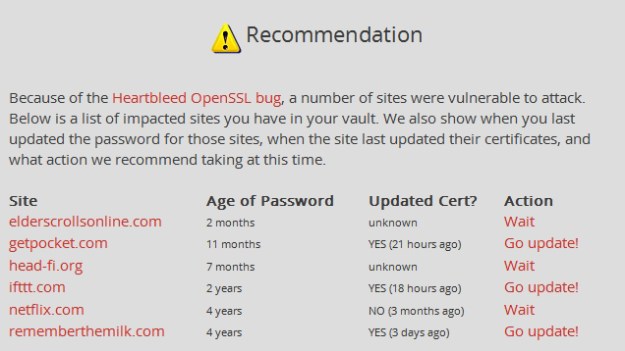
Due to the nature of the Heartbleed bug (read more here), you’ll need to wait until affected sites update their infrastructure before you change your passwords. LastPass’ ever-useful Security Check tool now includes recommendations for Heartbleed, letting you know which sites have closed the hole, when, and if you should update yet.P

To run the tool, just click on the LastPass extension and head to Tools > Security Check. After running the tool, you’ll get the results (shown above) so you know what passwords to change. Hit the link to read more.P

LastPass Now Tells You Which Heartbleed-Affected Passwords to Change.

Widespread Encryption Bug, Heartbleed, Can Capture Your Passwords

Some websites running SSL encryption, such as Airbnb, Pinterest, USMagazine.com, NASA, and Creative Commons, among others, were exposed to a major security bug called Heartbleed on Monday.

The bug was reportedly discovered by a member of Google’s security team and a software security firm called Codenomicon.

A number of other websites may, according to a list being distributed on GitHub, be vulnerable to the bug as well.

The bug affects web servers running Apache and Nginx software, and it has the potential to expose private information users enter into websites, applications, web email and even instant messages.

And while most security experts advise that you always use websites and services offering SSL security encryption whenever possible, the Heartbleed bug has the ability to allow malicious operators to defeat this security layer and capture passwords as well as forge authentication cookies and obtain other private information.

security patch for the bug was announced on Monday, but many websites are still playing catch up. That’s why websites like the Tor Project are, only somewhat tongue-in-cheek, advising that you stay off the Internet this week if you really care about your security.

Widespread Encryption Bug, Heartbleed, Can Capture Your Passwords.

Sintel Restored on YouTube Editorial | BlenderNation

It looks like the message came through – as of 9am this morning (CET), Sintel is available on YouTube again. In case you missed it, there was an outcry on the internet this weekend as it was pulled by Sony after alleged copyright infringement.

To put things into perspective, these YouTube takedowns are massively automated. Software scans all the uploaded media and flags any material where they detect copyrighted material. Large corporations such as Sony have enough traction with YouTube that they can then also automatically take down these media (smaller companies have to manually submit a DMCA takedown notice).

So is there still a problem? You bet there is – we’re lucky to have a huge and vocal community behind us, that spread this story over the web in a couple of hours. The story was featured on Cartoon BrewBoing BoingSlashdot and Reddit (which nuked the BlenderNation server for a few hours). This helped revert the takedown. If you’re a small publisher however, you will find it nearly impossible to talk to anyone and get your video back up. These automated takedowns can destroy your project and leave you powerless.

Boing Boing hits the nail on the head with their comment:

While it’s probably a mistake, because this is so brain-meltingly obviously wrong, it’s also a very stark example of how sloppy, over-broad, and consequence-free enforcement of copyright can damage culture.

I don’t think there was any intent behind this particular takedown – just an unfair, unaccountable system. I’m glad we got Sintel back.

Sintel Restored on YouTube Editorial | BlenderNation.

Blogger Pulls Off $30,000 Sting to Get Her Stolen Site Back


If you have a domain of your own, especially one for a business, this is a must-read. If you have an easily guessable password, you DEFINITELY must read this.

For several days last week, RamshackleGlam.com –- the domain name that I have owned and operated since March of 2010 –- did not belong to me, but rather to a man who goes by the name “bahbouh” on an auction website called Flippa.com, and who was attempting to sell off the site to the highest bidder (with a “Buy It Now” price of $30,000.00). He promised the winner my traffic, my files, and my data, and suggested that I was available “for hire” to continue writing posts (alternatively, he was willing to provide the winner with “high-quality articles” and “SEO advice” to maintain the site’s traffic post-sale).

I learned that my site was stolen on a Saturday. Three days later I had it back, but only after the involvement of fifty or so employees of six different companies, middle-of-the-night conferences with lawyers, FBI intervention, and what amounted to a sting operation that probably should have starred Sandra Bullock instead of…well…me.

Blogger Pulls Off $30,000 Sting to Get Her Stolen Site Back.

Kent Police fined £100,000 after interview tapes abandoned at former station | ICO news release

The ICO’s investigation found that Kent Police had no guidance or procedures in place to makes sure personal information was securely removed from former premises. The problem was made worse due to an apparent breakdown in communications between the various departments involved in the move.<

ICO Head of Enforcement, Stephen Eckersley, said:
“If this information had fallen into the wrong hands the impact on people’s lives would have been enormous and damaging. These tapes and files included extremely sensitive and confidential information relating to individuals, many of whom had been involved in serious and violent crimes. How a police force could leave such information unattended in a basement for several years is difficult to understand.

“Ultimately, this breach was a result of a clear lack of oversight, information governance and guidance from Kent Police which led to sensitive information being abandoned. It is only good fortune that the mistake was uncovered when it was and the information hasn’t fallen into the wrong hands.”

Kent Police fined £100,000 after interview tapes abandoned at former station | ICO news release.

Blocking IP ranges using IBLOCK lists and iptables

I’ve started looking at the iptables function within the Linux kernel, and found out, that with a bit of tinkering, you can use the IBLOCK lists to do a machine-wide block based on IP. You use pipes (gotta love ’em) to route them into ipset which allows you to create a set of IP addresses/ranges which then reference in the iptables. You can use wget or curl. If you use wget, you might need to use the quiet switch. You can use xargs to multi-download lists and concatenate. I’m tinkering with my download script at the moment.

First, create the set. Here, I have used a high maxelem number because I use a lot of IBLOCK’s lists. The “maxelem 1048576” can be omitted or the number reduced if you are only using one or a small number of IBLOCK lists.

ipset create IBLOCK hash:net maxelem 1048576

Second, download and add to the set if it doesn’t already exist. You can chain multiple lists into the wget or use xargs. For this example, I’m only using one.

wget -q "http://list.iblocklist.com/?list=bt_level1&fileformat=p2p&archiveformat=gz" -O- |
    gunzip |
    cut -d: -f2 |
    grep -E "^[-0-9.]+$" |
    gawk '{print "add IBLOCK "$1}' |
    ipset restore -exist

Finally, add rules into the iptables to drop package to and from IP addresses that exist in the set. This means that packets coming in from external IPs that match IP addresses in the set will not be answered.

iptables -I INPUT -m set --match-set IBLOCK src -j DROP
iptables -I OUTPUT -m set --match-set IBLOCK dst -j DROP

When I tried this with my IBLOCK download script, it seemed to kill TOR functionality as well, which I suspect means that IBLOCK have included the TOR IP range in one or more of their lists, so I’ll need to determine which one(s) they are and exclude them, as I do use TOR actively.

As with most things, there’s more than one way to do this, and this is one of many ways you could implement blocking behaviour.

Source: Dustin C. Hatch, Using PeerBlock lists on Linux

Port Knocking

Remember when you used to only open the door when a certain pattern of knocks was heard? You can do the same with ports – the so-called “Port Knocking”. It provides another layer of security to your system as ports are not opened until the correct knocking pattern is received.

Haven’t installed or tried this myself, but may do over the weekend.

http://www.boynux.com/how-to-enable-port-knocking-in-linux/?goback=.gde_102999_member_269001685

https://en.wikipedia.org/wiki/Port_knocking

http://www.microhowto.info/howto/implement_port_knocking_using_iptables.html

https://wiki.archlinux.org/index.php/Port_Knocking

http://www.debian-administration.org/articles/268

http://www.zeroflux.org/projects/knock/


Fix the iPhone’s Security Bug On Jailbroken Phones without Upgrading


Fix the iPhone’s Security Bug On Jailbroken Phones without Upgrading.